
.webp)
Location is one of the most important factors to consider when evaluating a real estate investment in Toronto. Two properties with similar prices, layouts, and square footage can perform very differently depending on where they are located. One may attract reliable tenants, offer opportunities to increase rental income, and appeal to future buyers. Another may struggle with vacancy, higher operating costs, or limited resale demand.
For real estate investors in the Greater Toronto Area (GTA), choosing the right location involves more than looking at a neighbourhood's reputation or assuming that properties in expensive areas are always better investments. It means understanding who wants to live there, how people get around, what services are nearby, what the local rental market looks like, and how the property's location may affect its long-term potential.
Location also matters when evaluating fixer-uppers, properties with additional-unit potential, and homes that could benefit from renovations or redevelopment. A property in the right location may offer opportunities that are not immediately obvious from the listing photos.
In this guide, we'll explore how location affects rental demand, cash flow, property appreciation, renovation potential, and investment risk, with practical considerations for Toronto and the surrounding GTA.
1. Rental Demand: Who Wants to Live in the Area?
One of the first questions investors should ask is: Who is most likely to rent this property, and why would they choose this location?
A property's rental potential depends partly on whether it meets the needs of the people looking for housing in that area. Different neighbourhoods attract different tenant groups, and understanding those preferences can help investors make better purchasing decisions.
For example, a condominium near downtown Toronto may appeal to young professionals who value transit access, restaurants, and proximity to employment centres. A detached home in a family-oriented neighbourhood may attract households looking for more bedrooms, outdoor space, and access to schools and parks. A property near a university or college may appeal to students, faculty, or staff, depending on the type of accommodation available.
When assessing rental demand, consider the following:
-
Employment opportunities: Is the property reasonably accessible to major employment areas, hospitals, business districts, or industrial centres?
-
Public transportation: Can residents commute without relying entirely on a car?
-
Schools and education: Are there schools, colleges, or universities that influence housing demand in the area?
-
Everyday amenities: Are grocery stores, parks, restaurants, healthcare services, and other essentials nearby?
-
Tenant preferences: Does the property's size, layout, and price align with the needs of the local rental market?
The key is to match the property to its likely tenant. A large house may not be the best investment if the surrounding area has limited demand for that type of rental, while a modest property in a well-connected neighbourhood could appeal to a broader tenant pool.
How to research local rental demand
Before making an offer, compare similar rental listings in the immediate area. Look at asking rents, property size, bedroom count, condition, included utilities, parking, and amenities.
Remember that asking rent is not necessarily the rent a landlord will achieve. Listings also do not tell you how long a property has been vacant or whether the advertised price reflects actual rental demand.
Where possible, review comparable rentals, speak with local property managers, and examine how long similar units remain available. This helps you build a more realistic rental estimate instead of relying on optimistic assumptions.
2. Transportation and Accessibility Can Influence Investment Performance
Transportation is an important consideration when evaluating a Toronto investment property. For many renters, the ability to commute efficiently can affect whether a property is attractive enough to consider.
Properties near subway stations, streetcar routes, bus connections, GO Transit stations, or major employment corridors may appeal to people who value convenient access to work and other destinations. However, proximity alone does not guarantee stronger rental demand or higher property values.
Consider a property in an established neighbourhood with convenient transit access compared with a similar property that requires a long drive to reach public transportation. Depending on the target tenant, the first property may have a competitive advantage.
Accessibility can also affect demand from future buyers. Someone purchasing a home for personal use may prioritize a shorter commute, while an investor may consider whether the location is attractive to tenants and whether that appeal is likely to remain relevant.
When evaluating transportation, look beyond the distance shown on a map.
-
Is the route practical for daily commuting?
-
How frequently does public transit operate?
-
Is the property walkable to a station or bus stop?
-
Are there reliable connections to employment centres?
-
Does the neighbourhood offer reasonable access to major roads?
-
Could traffic congestion or transportation construction affect convenience?
Future transit improvements may also influence investment decisions. However, proposed infrastructure should be treated as a possibility rather than a guaranteed source of appreciation. Review the project's official status, funding, construction timeline, and confirmed plans before assigning value to it.
3. Property Prices and Cash Flow: More Expensive Does Not Always Mean Better
A desirable neighbourhood can attract strong tenant interest, but it may also require a higher purchase price. This creates an important trade-off for investors.
A property in a premium Toronto neighbourhood might command higher rent than a similar property elsewhere, yet its purchase price, property taxes, maintenance expenses, and financing costs could make its cash flow less attractive.
Cash flow is the money left over after a property's rental income is used to cover its operating expenses and debt payments.
For a rental property, a basic monthly analysis should include:
-
Expected rental income
-
Mortgage payments
-
Property taxes
-
Insurance
-
Repairs and maintenance
-
Property management fees, if applicable
-
Utilities paid by the landlord
-
Vacancy and other operating allowances
-
Condominium fees, where applicable
For example, imagine two hypothetical investment properties:
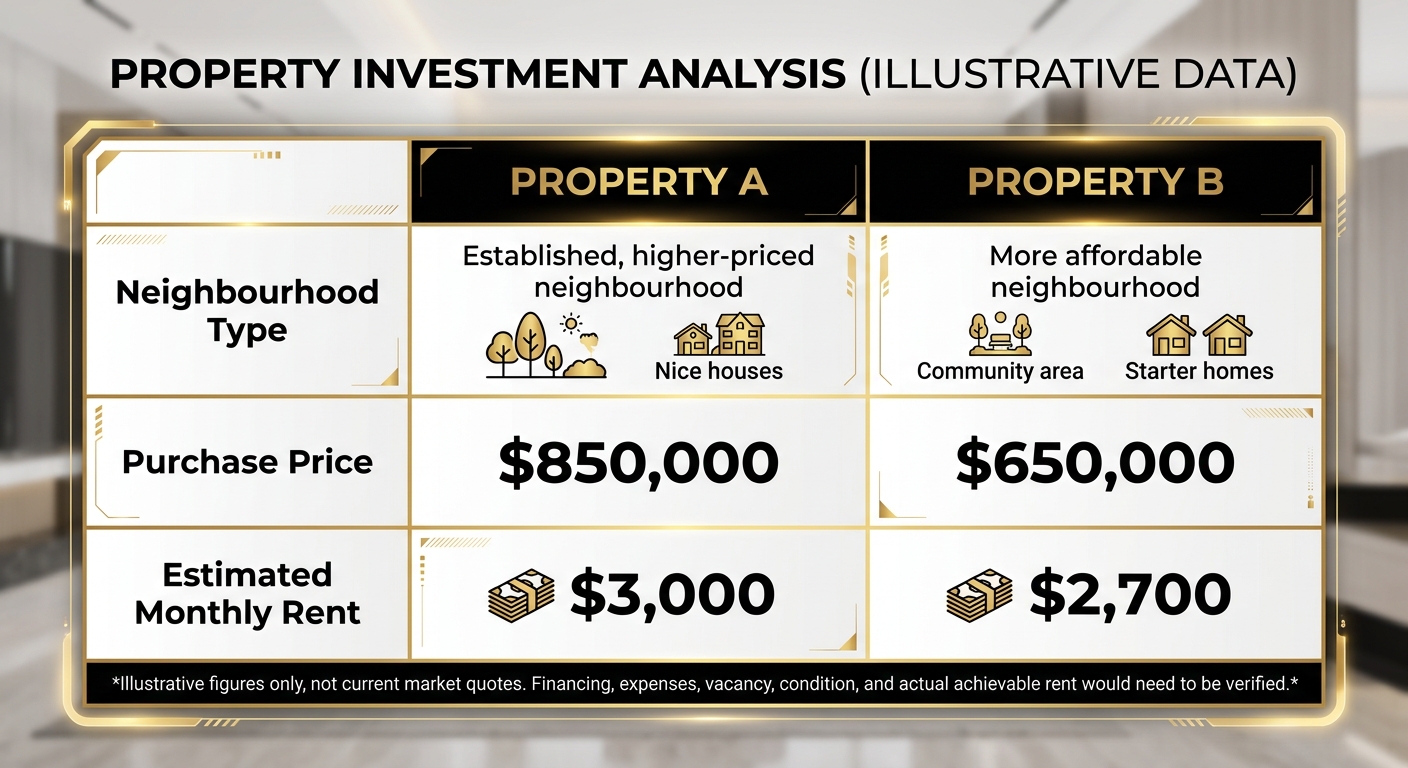
Property A generates $300 more in monthly rent, but it costs $200,000 more to purchase. Property B may offer a more favourable relationship between rental income and purchase price, although its actual performance depends on its expenses, financing, and risks.
One way to compare properties is the gross rental yield:
Gross rental yield=Annual rentPurchase price×100\text{Gross rental yield}=\frac{\text{Annual rent}}{\text{Purchase price}}\times100Gross rental yield=Purchase priceAnnual rent×100
Using the hypothetical figures above, Property A has a gross rental yield of approximately 4.24%, while Property B has a gross rental yield of approximately 4.98%.
Gross yield is only an initial screening tool. It does not account for operating expenses, financing, vacancies, or capital improvements. Investors should also calculate net operating income and assess cash flow under realistic financing assumptions.
The lesson is simple: don't pay a premium for a location without understanding how that premium affects the numbers.
4. Neighbourhood Trends and Long-Term Property Appreciation
Location can influence how a property performs over time, but appreciation is never guaranteed.
Investors often look for neighbourhoods that offer a combination of established demand, improving amenities, employment access, and potential future investment. These characteristics may support a property's appeal to future buyers and tenants, although market conditions and property-specific factors remain important.
In Toronto, it can be useful to examine several types of neighbourhoods.
Established neighbourhoods
Areas with existing infrastructure, established communities, convenient amenities, and a history of housing demand may appeal to investors seeking a more mature market.
The challenge is that these advantages may already be reflected in property prices. Investors need to determine whether the purchase price still makes sense relative to achievable rent, maintenance requirements, and potential future resale demand.
Emerging or changing neighbourhoods
Some areas may be experiencing new residential development, commercial investment, infrastructure improvements, or changes in the types of housing available.
These neighbourhoods may offer opportunities for investors who identify potential before it becomes widely recognized. However, planned development does not automatically translate into higher property values. Timelines can change, projects may be delayed, and additional housing supply can also affect competition among landlords.
Neighbourhoods with redevelopment potential
Some properties may offer possibilities beyond their current use. A larger lot, an existing multi-unit property, or a building that requires substantial renovation may attract buyers interested in creating additional value.
In these situations, the surrounding area matters. Local demand, nearby development patterns, lot characteristics, access, and applicable planning rules can influence whether a proposed project is practical.
Before purchasing based on future appreciation, compare historical sales, current comparable listings, local inventory, and the property's underlying fundamentals. Avoid assuming that a neighbourhood will improve simply because it is described as up-and-coming.
5. Renovation and Value-Add Opportunities Depend on Location
For investors who buy fixer-uppers or properties requiring improvements, location can determine whether renovation costs are likely to be justified by the result.
A property may be outdated but sit in an area where tenants or buyers are willing to pay for a modern kitchen, additional bathroom, improved layout, or better use of available space. In another location, the same renovation may not produce enough additional rental income or resale value to justify the expense.
This is why investors should evaluate renovation potential alongside neighbourhood demand.
For example, renovating a basement suite may be worth investigating where there is demand for smaller rental units. Improving a family home may make sense in an area where tenants value multiple bedrooms and usable outdoor space. Updating a property near employment centres may appeal to renters who prioritize convenience over luxury finishes.
Before moving forward, consider these questions:
-
What improvements do comparable properties in the neighbourhood offer?
-
Which renovations are most likely to appeal to the target tenant or buyer?
-
How much could the improvements reasonably cost?
-
What rental income or resale value might the improvements support?
-
Will the property remain competitive after renovation?
-
Are permits, inspections, or other approvals required?
A critical distinction is that physical potential does not automatically mean legal potential. A basement that looks suitable for a rental unit may not meet applicable building, fire safety, zoning, or other requirements.
Likewise, adding a bedroom, another dwelling unit, or a second storey may require approvals and technical assessments. Confirm current requirements with the municipality and appropriate professionals before including these improvements in your investment calculations.
The strongest value-add opportunities are not necessarily the properties needing the most work. They are the properties where the purchase price, renovation plan, location, and realistic end value align.
6. Zoning, Multiplex Potential, and Future Development
For investors interested in multiplexes, multi-unit properties, or redevelopment, location analysis needs to go beyond rental demand and neighbourhood appeal.
A property's zoning and planning context can influence what may be built, expanded, renovated, or used on the site. This is particularly relevant in Toronto, where investors may be interested in converting an existing property into multiple dwelling units or evaluating a lot for a different form of residential development.
However, two properties on the same street may have different physical constraints or development considerations. Lot dimensions, frontage, building configuration, access, servicing, heritage status, and other site-specific factors can affect what is feasible.
Before purchasing a property based on its development potential, investigate:
-
Current zoning and permitted uses: Confirm what the applicable rules allow for the specific property.
-
Lot dimensions and configuration: Consider frontage, depth, access, and the practical layout of the site.
-
Existing building conditions: Determine whether the structure can reasonably support the proposed improvements.
-
Municipal requirements: Check applicable planning, building, fire safety, parking, and servicing requirements.
-
Construction feasibility: Obtain professional advice on design, engineering, construction costs, and required approvals.
-
Market demand: Determine whether the proposed units or completed development would appeal to likely tenants or buyers.
Toronto's planning policies and housing rules can change, so do not rely solely on an agent's comments, an online listing, or a general statement about what is permitted in a neighbourhood.
Verify current property-specific requirements with the City of Toronto or the relevant municipality. Depending on the project, a planner, architect, designer, surveyor, or other qualified professional may be needed to assess feasibility.
For investors considering value-add opportunities, the distinction between a property's potential and its confirmed development permissions is especially important. A promising lot can still become an unsuitable investment if the anticipated project cannot be approved or completed within the expected budget.
7. Property Taxes, Operating Costs, and Neighbourhood-Specific Risks
Location affects more than rent and resale value. It can also influence a property's operating costs and exposure to risk.
Two properties with similar rental income may have different financial outcomes because of differences in taxes, insurance, maintenance needs, building condition, or condominium fees.
When comparing locations, consider the following factors.
Property taxes and municipal costs
Review the property's current property tax information and understand which municipal services or charges may affect the investment. Do not assume that properties with similar purchase prices will have identical carrying costs.
For multi-unit or redevelopment projects, confirm whether changes to the property could affect its assessment or other applicable charges.
Insurance and physical risks
Some properties may face higher insurance costs because of building age, previous claims, construction type, or exposure to particular risks. Depending on the location, investors may also need to investigate flood exposure, drainage, and other environmental considerations.
Check available flood-risk information and obtain an insurance quote before finalizing your financial projections.
Maintenance and future capital expenses
Neighbourhood conditions can influence the practical costs of owning a property, but the building itself is equally important. An older home may require significant work on its roof, plumbing, electrical systems, foundation, or windows.
A lower purchase price does not necessarily mean a lower-cost investment. A thorough inspection and realistic repair budget can help prevent unexpected expenses from undermining the investment.
Vacancy and competition
An area with many similar rental units may offer tenants more choices. New construction can create competition, while changes in local employment or tenant preferences can affect demand.
Review competing rentals and consider how your property would stand out. A well-maintained unit with a practical layout and competitive rent may be better positioned than a property relying solely on its neighbourhood's reputation.
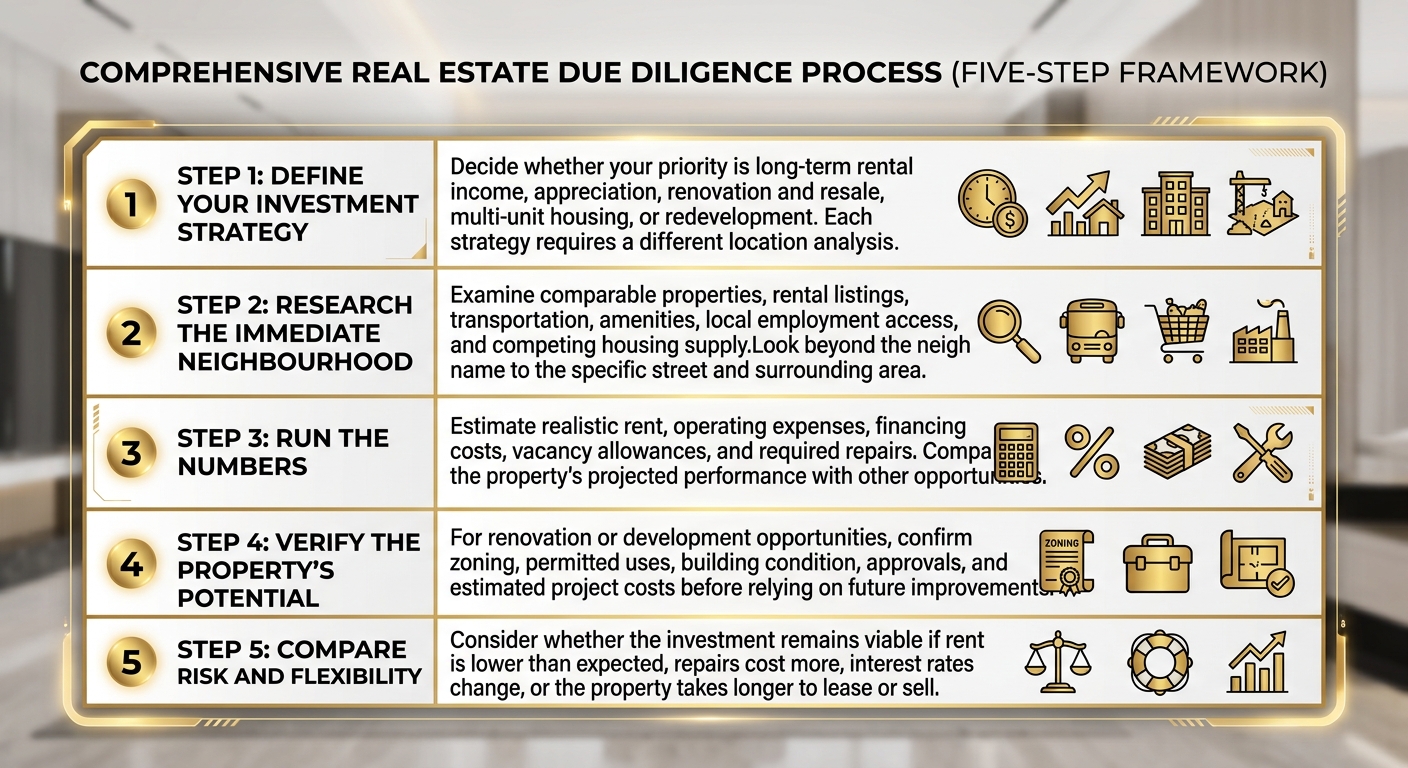
8. How to Compare Toronto Investment Locations Before Buying
Instead of choosing a neighbourhood based on general impressions, use a consistent process to compare potential investments.
9. Common Mistakes When Choosing an Investment Property Location
Even experienced buyers can overlook important details when evaluating an investment.
Choosing a neighbourhood based on reputation alone. A well-known area is not automatically the most profitable location. The purchase price must make sense relative to income, expenses, and investment objectives.
Assuming transit proximity guarantees appreciation. Transit can support convenience and housing demand, but its effect depends on the property's price, the local market, and other factors.
Overestimating future rent. A rent estimate should reflect comparable units, property condition, applicable rental rules, and realistic tenant demand. Do not base a purchase solely on the highest asking rents you find online.
Ignoring the specific street or property. Neighbourhood averages can conceal differences in noise, traffic, access, surrounding land uses, and building condition.
Paying for unconfirmed development potential. A lot may appear suitable for a multiplex or expansion, but that does not establish that the proposed project is permitted or financially feasible.
Focusing on purchase price instead of total cost. Closing costs, repairs, ongoing expenses, financing, and potential vacancy all affect the investment's financial outcome.
The goal is not to find a perfect neighbourhood. It is to identify a property in a location that supports your strategy at a price that accounts for both opportunity and risk.
Frequently Asked Questions
1. What is the most important location factor for a Toronto investment property?
There is no single factor that applies to every investment. Rental demand, transportation, employment access, purchase price, operating costs, and future resale appeal all matter. The most important considerations depend on whether your goal is rental income, appreciation, renovation, or redevelopment.
2. Is it better to buy an investment property downtown Toronto or in the suburbs?
Neither is automatically better. Downtown properties may appeal to tenants who prioritize transit, employment access, and urban amenities. Suburban properties may appeal to families or renters looking for additional space. Compare actual purchase prices, achievable rents, expenses, vacancy risks, and tenant demand before deciding.
3. Does proximity to public transit increase investment property value?
Convenient transit access can improve a property's appeal to some buyers and renters. However, it does not guarantee appreciation or higher rental income. The effect depends on the type of transit, accessibility, local demand, surrounding properties, and the price paid.
4. How can I find a neighbourhood with strong rental potential?
Start by identifying your target tenant and comparing similar rental properties in the area. Research employment access, transportation, amenities, rental competition, and local housing supply. Validate your rent estimates using comparable listings and, where possible, local property management expertise.
5. How do I determine whether a property has multiplex or redevelopment potential?
Begin with the property's location, lot dimensions, existing building, and applicable planning rules. Verify current zoning and municipal requirements, then consult the appropriate planning and building professionals to assess feasibility, approvals, costs, and timelines. Never assume a proposed development is permitted based on location alone.
Conclusion: The Right Location Is the One That Supports Your Investment Strategy
Location affects nearly every part of a real estate investment, from tenant demand and rental income to operating expenses, resale appeal, and redevelopment opportunities.
For GTA investors, the best approach is to look beyond a neighbourhood's reputation and examine how a specific property fits the intended investment strategy. A property with strong rental demand may still be overpriced. A fixer-upper may offer attractive value-add potential, but only if the renovation costs and likely end value make sense. A larger lot may look promising for redevelopment, but its feasibility must be verified.
The most useful question is not simply, "Is this a good neighbourhood?" It is, "Does this particular property, at this particular price, offer a realistic opportunity based on the location, the numbers, and the risks?"
A disciplined evaluation can help you recognize opportunities that other buyers overlook while avoiding investments that depend on assumptions rather than evidence.
If you're thinking about buying, selling, or investing in the GTA, I'd be happy to help you understand what the current market means for your specific situation.
Call me anytime at (647) 207-0470, or book a conversation with Sol Yasin. You can also explore the latest market update and homes currently available on the market to identify opportunities that align with your goals.